- Home Page
- Compnay Profile
-
Our Products
- Oil Seeds for B2B Sourcing
- Processed Spices for B2B Sourcing
- Flour Products for B2B Sourcing
- Pulses for B2B Sourcing
- Cereal Products for B2B Sourcing
- Sweeteners for B2B Sourcing
- Condiments for B2B Sourcing
- Snacks for B2B Sourcing
- Beverage Products for B2B Sourcing
- Natural Products for B2B Sourcing
- Dairy Products for B2B Sourcing
- Cooking Oils for B2B Sourcing
- Herbal Products | Bulk & Wholesale Supply
- Kitchen And Dining Supplies for B2B Sourcing
- Blogs

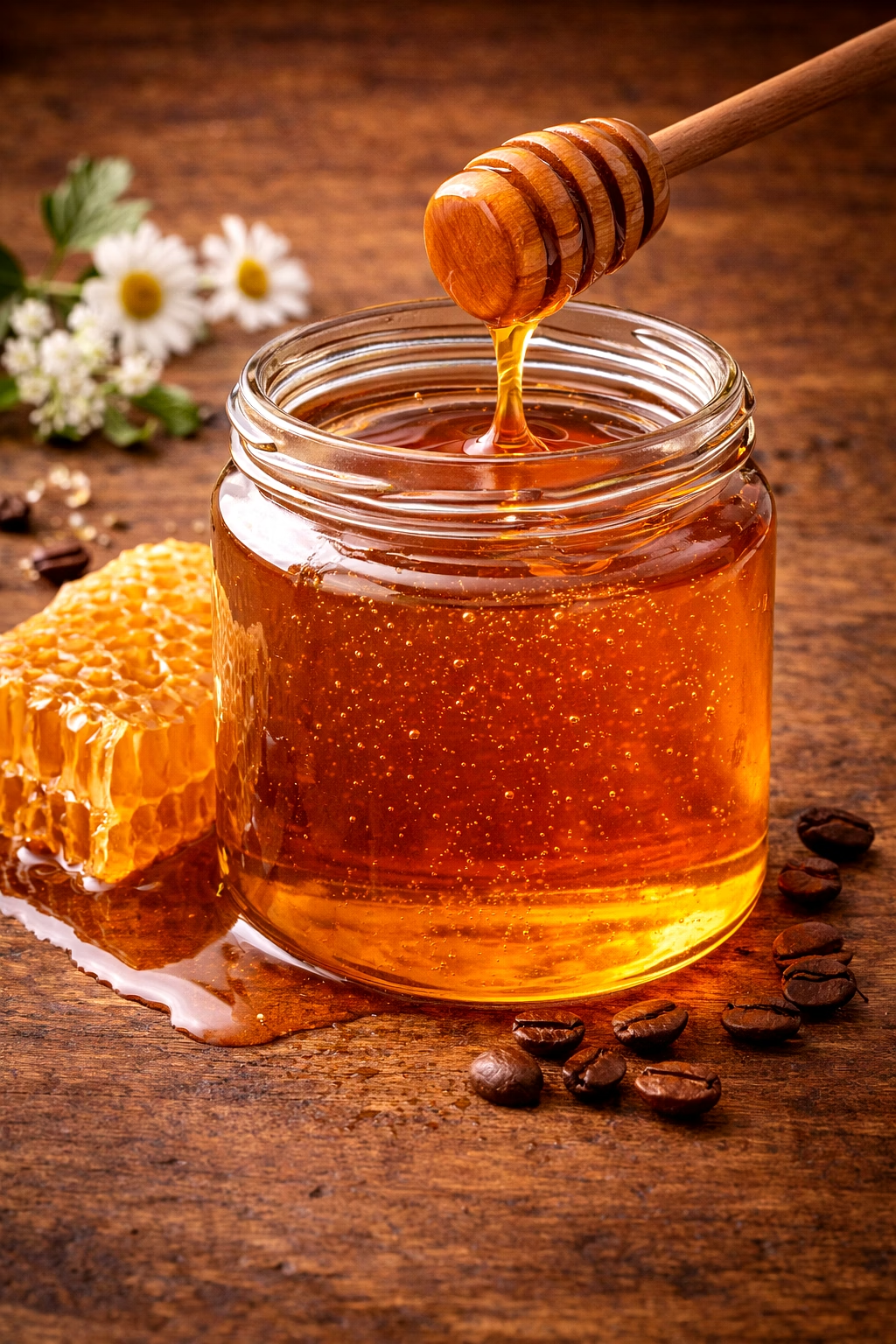
Honey (Natural) - Bulk Wholesale Supply for importers, wholesalers & food brands for international buyers
-
Product is not available
Country Of Origin : India
Honey (Natural) – Natural Products Bulk Export
Honey (Natural) is an apiculture-derived raw material categorized under natural sweeteners for structured Natural Products Bulk Export programs. Offered in raw variants and processed variants, the product is moisture-controlled and supplied in bulk drums with export-grade packaging aligned for Industrial Natural Product Traders and Global Natural Product Distribution networks. Multi-floral and mono-floral India-sourced lots are traceable to collection regions, supporting regulated pharmaceutical and cosmetic market sourcing requirements.
Its stable moisture parameters and filtration control enable consistent viscosity, crystallization behavior, and microbial safety during long-term storage. Designed for Honey (Natural) bulk sourcing India initiatives, the product supports Honey (Natural) export procurement contracts, private labeling and contract manufacturing, and export ready natural products bulk shipments for manufacturers operating under structured sourcing agreements.
Key Features
- Multi-floral and mono-floral traceability for formulation consistency
- Moisture-controlled processing to manage fermentation risk
- Filtration and sediment reduction for stable clarity profiles
- Bulk drum configuration suited for industrial dispensing systems
Technical Attributes
- Moisture Level Control – Regulated water content limits osmophilic yeast growth, improving storage stability
- Viscosity Consistency – Uniform density supports automated filling and blending operations
- Microbial Screening – Batch-level testing enables regulated pharmaceutical and cosmetic market sourcing
- Export-Grade Drum Packaging – Structural integrity suitable for long-distance containerized transport
Honey (Natural) – Multi-Floral & Mono-Floral India-Sourced Composition Framework
Derived from nectar collected by Apis species across diverse Indian floral regions, this natural honey consists primarily of fructose and glucose with minor enzymatic components such as invertase and diastase that influence sweetness perception and breakdown stability. Multi-floral variants reflect composite nectar sources, generating balanced sugar ratios and broad aromatic notes, while mono-floral lots demonstrate characteristic flavor markers linked to dominant botanical origins. These compositional distinctions allow Contract Natural Goods Suppliers to align procurement with end-product sensory or functional requirements.
Raw variants retain native enzymes, pollen traces, and natural wax micro-particles, making them suitable for minimally processed food and wellness applications. Processed variants undergo controlled heating and micro-filtration to reduce suspended solids while preserving structural sugar integrity. Moisture calibration plays a critical role in preventing fermentation during storage, especially under tropical logistics conditions common in global natural products trading company supply chains. Batch-level testing for HMF values and microbial counts ensures stability within wholesale plant based products trade supply frameworks.
Functional Performance & Operational Efficiency
Low water activity contributes to inherent microbial resistance, supporting extended shelf stability in bulk environments. Stable viscosity enables predictable pumping and transfer within industrial blending tanks, minimizing residue loss during high-volume operations. Controlled crystallization behavior allows manufacturers to manage texture outcomes in confectionery, nutraceutical syrups, and cosmetic bases.
Bulk drums are engineered for stacking resilience and sealed to prevent moisture ingress, preserving chemical stability during maritime transport. Such structural safeguards are critical for industrial natural ingredient procurement programs operating under long term natural product distribution agreements. Filtration control also reduces sedimentation, improving downstream homogenization when integrated into large-scale production lines.
Application & Industry Deployment
Honey integrates into food processing, beverage formulation, herbal preparations, pharmaceutical syrups, and cosmetic emulsions. Its sugar matrix functions as both sweetening agent and humectant, supporting moisture retention in topical and edible systems. Under natural goods sourcing contracts for manufacturers, product grades can be aligned with viscosity, color index, and floral origin requirements.
Supply structures accommodate bulk natural products exporters for importers seeking consistent lot volumes with documented traceability. Private labeling and contract manufacturing enable customized drum labeling, retail repacking, and specification alignment. Export documentation, phytosanitary certification, and quality dossiers are coordinated to facilitate global natural product distribution while maintaining regulatory conformity across destination markets.
Frequently Asked Questions
Frequently Asked Questions
- Which variants are available? Multi-floral and mono-floral raw or processed variants are supplied.
- Is bulk export documentation provided? Yes, documentation supports Natural Products Bulk Export compliance.
- Can specifications be customized? Moisture level and filtration grade can align with contract based natural goods supply agreements.
- What packaging formats are used? Industrial bulk drums with export-grade sealing are standard.
- Is it suitable for regulated industries? Batch testing enables regulated pharmaceutical and cosmetic market sourcing.