- Home Page
- Compnay Profile
-
Our Products
- Oil Seeds for B2B Sourcing
- Processed Spices for B2B Sourcing
- Flour Products for B2B Sourcing
- Pulses for B2B Sourcing
- Cereal Products for B2B Sourcing
- Sweeteners for B2B Sourcing
- Condiments for B2B Sourcing
- Snacks for B2B Sourcing
- Beverage Products for B2B Sourcing
- Natural Products for B2B Sourcing
- Dairy Products for B2B Sourcing
- Cooking Oils for B2B Sourcing
- Herbal Products | Bulk & Wholesale Supply
- Kitchen And Dining Supplies for B2B Sourcing
- Blogs

Beverage Products for B2B Sourcing

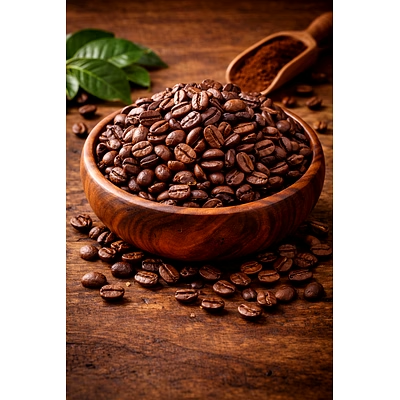
Coffee Beans / Powder - Bulk Wholesale Supply for roasters, packers & wholesalers for international buyers
Coffee Beans / Powder – Beverage Products Bulk Trade
Coffee Beans / Powder are plantation-origin beverage commodities structured for beverage products bulk trade across roasting, blending, and packaging industries. Sourced as traceable Arabica and Robusta lots from India-origin estates, the portfolio includes green beans variants, roasted variants, and ground variants configured for industrial beverage distributors and beverage export suppliers. Bulk sacks and export-grade packaging formats are aligned with global beverage distribution requirements.
Through Coffee Beans / Powder bulk sourcing India programs, buyers secure consistent bean grading, roast uniformity, and grind calibration suited for wholesale beverage supply for manufacturers. Structured Coffee Beans / Powder export procurement contracts and private labeling and contract manufacturing models support long term beverage trade agreements and export compliant beverage bulk shipments across multi-market supply chains.
Key Features
- Arabica and Robusta variants with traceable India-origin sourcing
- Green, roasted, and ground formats for flexible processing integration
- Controlled roasting profiles for flavor consistency
- Bulk sacks and export-grade packaging for containerized trade
Technical Attributes
- Origin Traceability – Enables lot-level quality verification for global beverage distribution contracts
- Roast Profile Calibration – Supports predictable extraction yield in commercial brewing systems
- Grind Size Standardization – Ensures compatibility with espresso, filter, and industrial brew lines
- Bulk Supply Configuration – Structured for bulk beverage products exporters worldwide
Price upon request
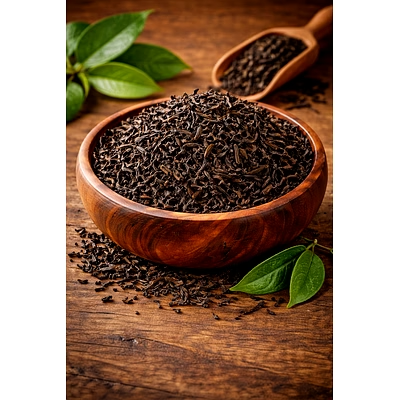
Tea Leaves - Bulk Wholesale Supply for roasters, packers & wholesalers for international buyers
Tea Leaves – Beverage Products Bulk Trade
Tea Leaves are plantation-based beverage commodities categorized for beverage products bulk trade across blending, packaging, and institutional beverage programs. Offered in loose leaf grades including Dust, BOP, and OP, along with India-origin specialty grades, the product aligns with beverage export suppliers and industrial beverage distributors managing global beverage distribution networks. Bulk cartons and export packaging formats are structured for efficient logistics handling.
Through Tea Leaves bulk sourcing India initiatives, buyers access consistent leaf grading, oxidation control, and flavor stability suited for wholesale beverage supply for manufacturers. Structured Tea Leaves export procurement contracts and private labeling and contract manufacturing frameworks support beverage sourcing contracts for distributors and long term beverage trade agreements across international markets.
Key Features
- Loose leaf grades including Dust, BOP, and OP classifications
- India-origin black, green, and specialty tea profiles
- Controlled oxidation and drying for flavor stability
- Bulk cartons with export packaging for large-scale trade
Technical Attributes
- Grade Differentiation – Enables tailored infusion strength for retail and institutional blends
- Moisture-Controlled Drying – Preserves aroma compounds during extended storage
- Leaf Size Classification – Supports predictable brewing time and liquor clarity
- Bulk Packaging Format – Configured for bulk beverage products exporters worldwide
Price upon request
A. Category Definition
These beverage products refer to a broad collection of items commonly sourced for professional kitchens, distributors, manufacturers, and retail channels. The category should be understood as a multi-SKU assortment with multiple variants, pack sizes, and quality tiers, not a single item.
Includes:
- Ready-to-drink beverages (where applicable to the category)
- Beverage concentrates and syrups
- Drink mixes (powdered or instant)
- Functional and flavored beverage variants
- B2B packs for food service and retail channels
Excludes:
- Alcoholic beverages (regulated)
- Medical nutrition with therapeutic claims
- Single-brand promotional merchandise
- Standalone packaging materials
Examples:
- Tea Leaves (example item/variant)
- roasters (example item/variant)
- packers & wholesalers (example item/variant)
B. What These Products Are Used For
Items in this category are used to support day-to-day operations where consistent supply, predictable performance, and repeatable results matter. Buyers typically use them to equip workflows, maintain product assortments, or feed downstream production and service needs. The goal is reliable availability across batches, locations, and reorder cycles.
C. User Intent Alignment
- Buying: Procurement teams source multiple options to meet budget, lead-time, and channel requirements across United Arab Emirates, Iraq, United States, Iran, Russia.
- Comparing: Buyers evaluate alternatives by materials, formats, packaging, and suitability for specific workflows rather than one “best” item.
- Learning: Teams confirm typical use, handling, storage, and market expectations before onboarding new suppliers.
- Replenishing: Many orders are repeat purchases, so consistency across reorders and lot-to-lot variation management are prioritized.
D. Key Variations Within the Category
- Format (RTD, concentrate, powder)
- Flavor profiles (plain, flavored, functional)
- Sweetening approach (sugared, reduced, alternative sweeteners)
- Packaging format (bottles, cans, sachets, bulk)
- Serving context (retail, vending, HoReCa)
- Shelf-stability approach (ambient vs chilled supply)
- Quality tier and positioning (value to premium)
E. Use Cases & Scenarios
Common scenarios include hotels and cafés standardizing beverage menus, distributors supplying vending and retail chains, and food brands expanding flavored drink portfolios. Depending on the buyer, these products may be specified for front-of-house presentation, back-of-house throughput, manufacturing inputs, or resale assortments. Multi-location operators often standardize a shortlist to simplify training and replenishment.
F. Selection Guidance
To choose between options, start with the intended workflow and buyer profile: food service buyers may favor durability and ease of cleaning, while retail buyers may prioritize presentation and packaging. For ingredient-oriented categories, consider flavor/functional profile, processing level, and storage stability. Across all cases, balance cost, consistency, minimum order expectations, and supplier reliability for your markets.
G. Internal Entity Relationships
Subcategories commonly include: Drink mixes, Concentrates, Ready-to-drink. Complementary purchases often involve sweeteners, snacks and processed foods, dairy products for mixing, condiments and pantry items for food service. Related decisions may include private-label readiness, labeling language for cross-border trade, and the logistics needed for your destination markets. This helps buyers build complete baskets rather than sourcing items in isolation.